

Samsung’s 2nm Gamble, Exynos 2600: Let’s call a spade a spade for a second. If you follow smartphone hardware, you already know the tech community’s favourite whipping boy. Samsung’s Exynos processor has been the silicon we all loved to hate for years.
You probably know the painful drill by now: You spend big bucks on a premium Galaxy flagship across Europe or parts of Asia. Your prize? The home-grown Exynos chip. Meanwhile, US and South Korea buyers went for the might Qualcomm Snapdragon equivalent.
For a good five years the story never changed a whit. Phones with Snapdragon chips ran hotter. They had much better battery life. They pushed much higher frame rates during long mobile gaming hounds. Buyers of Exynos devices, however, often found themselves with thermally throttling devices and wondering why they paid the same prices for a compromised experience.
The Elephant in the Room: A Rocky Legacy
The Low Point of 2022
That harsh reality hit its absolute lowest point a few years ago. We all remember the thermal nightmare of the Exynos 2200 back in 2022. It confidently promised console-level gaming with a shiny AMD GPU. What did it actually deliver? Mostly just excess heat and stuttering frames.
A Gritty Redemption Arc
But semiconductor timelines move at breakneck speeds. Since that historical low point, Samsung’s chip division has quietly executed a gritty, determined redemption arc. The Exynos 2400 closed the performance gap significantly, proving the engineering team wasn’t ready to throw in the towel just yet.
Now, the stakes are exponentially higher. Samsung doesn’t want to settle for just being a “good enough” alternative anymore. They want total, undisputed Android domination. Their weapon of choice? The highly anticipated Exynos 2600, built on a bleeding-edge 2-nanometer (2nm) manufacturing node.
Why 2 Nanometers is a Total Game-Changer
Shrinking Transistors, Expanding Problems
In the first place, you have to talk about the physical limits of modern silicon to understand the hype of this particular processor. Today, “2nm” is mostly just marketing-speak, because it no longer refers to a physical gate length. But that’s a big architectural wall.
Physics starts to rebel when you try to stuff billions of tiny transistors into a space smaller than a postage stamp. Electrons literally stop doing what you want them to do. They leak out uncontrollably . They generate huge amounts of extra heat, which instantly kills battery life and throttles overall performance.
The GAA Head Start Nobody is Talking About
Samsung could have a huge secret advantage in this particular engineering problem. The foundry giant TSMC stayed with the older, highly reliable “FinFET” transistor architecture for their early 3nm chips while Samsung took a painful gamble. They went aggressively early into a brand new technology called Gate-All-Around (GAA).
The silicon channel is surrounded by the GAA on all four sides. Without getting too bogged down in complex electrical engineering terms, This structural change allows for incredibly precise control over the electrical current. This greatly reduces power leakage and increases efficiency across the board.
Yes Samsung’s early 3nm GAA yields were notoriously bad. It was a textbook example of early adopter pain. But that manufacturing headache is something that means a lot for the hardware landscape today. Samsung is maturing a multi-generational mature GAA process with the 2nm Exynos 2600. On the other hand TSMC is forced to use GAA for the first time on their respective 2nm node.
Samsung’s 2nm Gamble Spec Showdown
Before we dive into graphics and real-world efficiency, let’s look at the raw hardware comparison between the two titans battling for Android hardware dominance.
| Feature | Samsung Exynos 2600 | Qualcomm Snapdragon 8 Elite Gen 5 |
| Manufacturing Process | 2nm GAA (Samsung Foundry) | 3nm N3P (TSMC) |
| CPU Architecture | 10-core (Deca-core) | 8-core (Octa-core) |
| Peak Clock Speed | Up to 3.8 GHz | Up to 4.6 GHz |
| Graphics Unit (GPU) | Samsung Xclipse 960 | Qualcomm Adreno 840 |
| Multi-Core Benchmark | ~11,250 (Geekbench 6) | ~11,500 (Geekbench 6) |
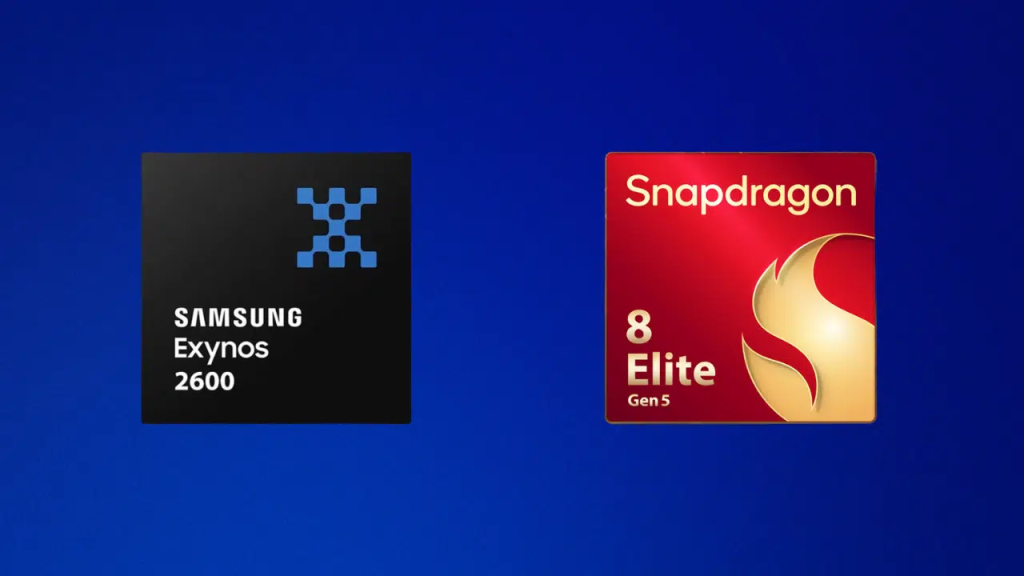
As the table makes perfectly clear, Samsung is going all in on a massive 10-core configuration and the natural efficiency of 2nm GAA to keep pace with Qualcomm’s ludicrously fast 4.6 GHz peak clocks. The raw figures are closer than they’ve been in a while, providing the ingredients for a fascinating real-world showdown.
Tearing Down the Graphics Architecture
Aiming for the Apple M5 Standard
Let us see what is under the hood because this is where things get really interesting in the graphics department. For years Samsung had a high-profile, if somewhat rocky, relationship with AMD. The new Xclipse 960 GPU is technically still based on AMD DNA for its core architecture, but Samsung’s engineers have heavily customised it for this particular 2nm node.
The industry just saw Apple’s M5 chip set a terrifyingly high bar for graphical efficiency for mobile silicon. Samsung is going straight for the jugular. They know that raw peak power is irrelevant if the thermal envelope is too small to cope.
AI-Driven Frame Generation Enters the Chat
The trick this year is a proprietary graphics optimisation driven by AI. The chip employs machine learning to reconstruct low-resolution images into razor-sharp output, which dramatically slashes the GPU’s overall workload.
For mobile games that are graphically intensive, this translates into uninterrupted buttery-smooth gameplay without the phone turning into a literal toaster. Where the Exynos line has traditionally fallen short is sustained performance, not just five minutes of peak benchmark score. If the 2nm thermal management is right, the Xclipse could finally give the heavyweights a serious blow.
The Qualcomm Juggernaut and Internal Pressure
Navigating the 2026 Hardware Price Crisis
The ultimate reality check is tough and unforgiving. Qualcomm is a total monster when it comes to mobile processing. There’s a very good reason their Snapdragon architecture remains the undisputed gold standard. Their Adreno GPUs are legendary for getting raw power and thermal efficiency bang on.
The current 2026 hardware price crisis is only adding to the chaos. Silicon prices are soaring, this means consumers are less tolerant than ever. If you’re paying ultra-premium prices in today’s inflated market, you expect flawless performance right out of the box. There is no room for error and buyers will not settle for second-tier frame rates.
The Final Verdict: Miracle or Mirage?
Can the Exynos 2600 really do this miracle? The ingredients for a massive, industry-shaking upset are most definitely all right there on the table. That painful early transition to GAA technology gives Samsung a theoretical leg up on the tricky physics of 2nm manufacturing.
If Samsung Foundry can finally get their act together and lock down high yield rates and banish their historical thermal dissipation bugs we could see a massive power shift. The Exynos team is fighting for its absolute life and the result could be the most exciting Android processor in well over a decade. Eyes on the silicon! The real battle has only just begun.
